
Why Your Brain Prefers a Message to a Phone Call - The science of attention, control and modern customer communication
For more than a century, businesses have told customers to pick up the phone. Today, more and more customers choose to send a message instead. This is not simply a change in technology. There is something deeper at work — the way our brains process attention, uncertainty, control and communication.

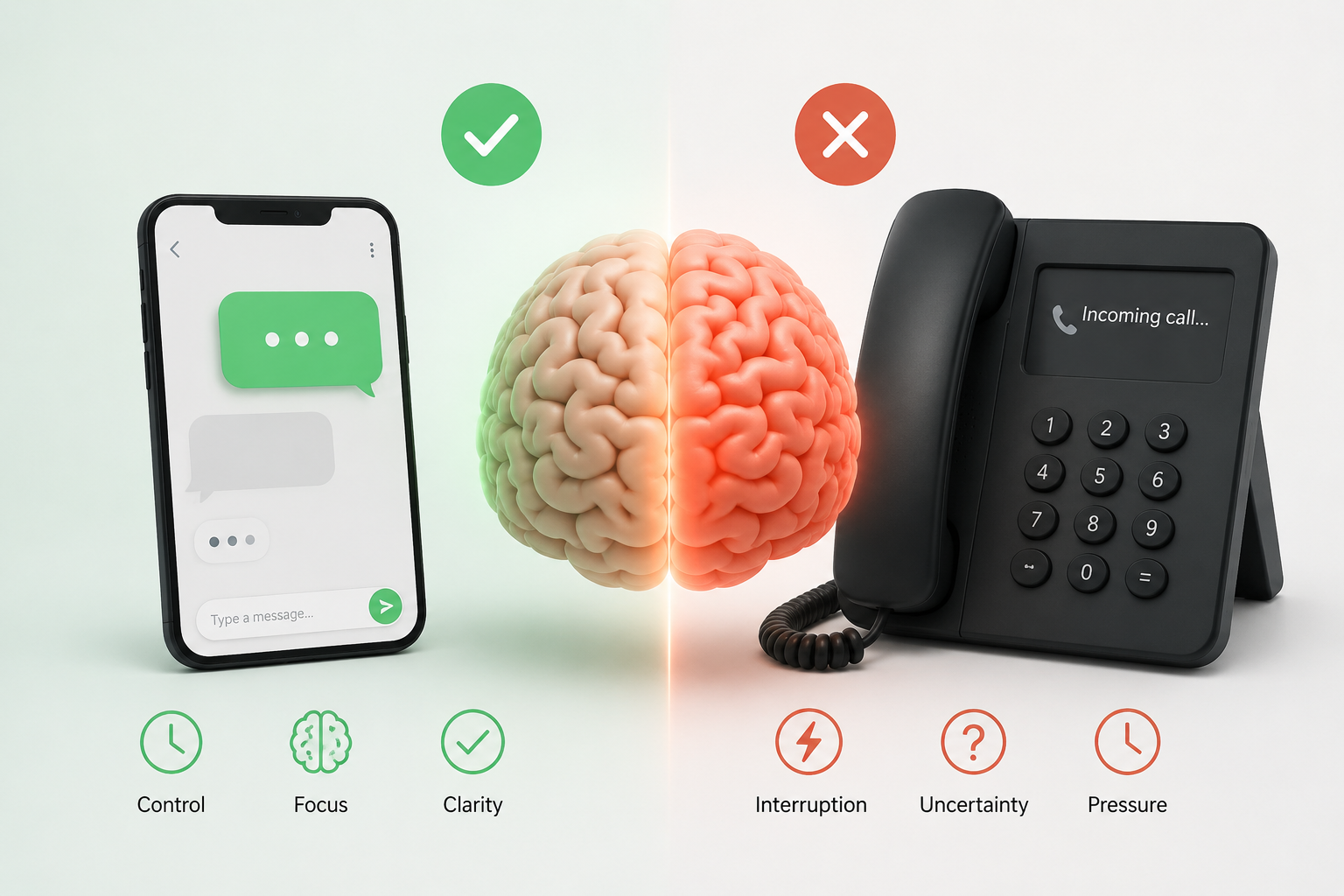
For more than 100 years, the phone was the ultimate communication channel. A customer had a question? Call us. A customer needed support? Call us. A customer wanted to buy something? Call us.
The phone represented direct human connection. But something fundamental has changed. Customers are not becoming less social. They are not rejecting human interaction. They are rejecting forced interaction.
The modern customer does not want fewer conversations. They want conversations that respect their attention, their time, and the way their brain naturally processes information. And neuroscience helps explain why messaging has become one of the most natural communication channels between humans and businesses.
The brain does not like interruption
A phone call creates an immediate demand for attention.
When a phone rings, the brain has to instantly switch states:
Who is calling?
Why are they calling?
Should I answer now?
Do I have enough information?
How should I respond?
A call forces the brain into a real-time communication mode. There is no preparation time. No opportunity to gather information. No ability to pause.
The customer must immediately move from whatever they were doing into a new cognitive task.
This matters because the human brain has limited attentional resources.
Research in cognitive psychology has shown that telephone conversations can interfere with sustained attention. One study found that the impairment was linked specifically to the active generation of verbal responses — not simply to listening. In other words, the brain is not just receiving information; it is continuously formulating responses while interpreting meaning and managing the interaction.
Research in cognitive psychology has shown that telephone conversations can interfere with sustained attention. One study found that the impairment was linked specifically to the active generation of verbal responses — not simply to listening. In other words, the brain is not just receiving information; it is continuously formulating responses while interpreting meaning and managing the interaction. https://pubmed.ncbi.nlm.nih.gov/19001580/
Messaging creates a different neurological experience.
The customer decides:
• When to read
• When to answer
• How much attention to dedicate
• What information to provide
Messaging does not remove the conversation. It removes the interruption.
Humans prefer control over uncertainty
One of the strongest drivers of human behaviour is the desire to reduce uncertainty. A phone call creates uncertainty:
"How long will this take?"
"Will they ask me something I cannot answer?"
"Will I feel pressured?"
"Can I explain my problem clearly?"
The brain generally prefers environments where it can predict and control what happens next. Messaging provides that control. The customer can:
• Read the conversation history
• Think before responding
• Collect information
• Ask better questions
• Return later if needed
The interaction becomes less like an interruption and more like a process.
Instead of: "I have to deal with this right now."
It becomes: "I can handle this when it works for me."
That psychological shift is extremely powerful.
Writing changes the way people think
There is another important difference between speaking and writing. Speaking is immediate. Writing is reflective.
When someone talks on the phone, they produce thoughts in real time. They must formulate answers while simultaneously listening, interpreting, and maintaining the social flow of the conversation. Writing creates a small but important pause. That pause allows people to:
• Organise their thoughts
• Compare options
• Review information
• Formulate more precise questions
• Make more deliberate decisions
For businesses, this changes the quality of the conversation. A customer who writes: "I am comparing three solutions. Can you explain the differences?" is already in an evaluation mindset. They are not just contacting a company. They are entering a decision process.
Messaging lowers psychological barriers
Many customers do not avoid calling because they do not need help. They avoid calling because calling creates friction. A phone conversation requires:
• Finding the number
• Waiting for someone to answer
• Explaining the situation verbally
• Repeating information
• Staying available until the conversation ends
Messaging removes much of this friction. A customer can simply write: "Hi, I have a question about my order." The conversation has started. No waiting. No queue. No commitment.
Research into mobile communication behaviour has shown that text-based communication provides users with greater control over timing and self-presentation, making it attractive for many everyday interactions. (core.ac.uk)
The biggest misconception: messaging is less personal
Many companies still believe: "Talking to customers is personal. Messaging is technology." But this misunderstands modern human communication. People do not define a personal interaction by the channel. They define it by the experience. They ask:
• Was my problem understood?
• Did I get a useful answer?
• Was the company available when I needed it?
• Did they remember my context?
A customer does not feel valued because they spent 20 minutes waiting on hold. They feel valued because someone solved their problem quickly.
A relevant message at the right moment can feel much more personal than an anonymous voice in a call centre.
The smartphone changed customer expectations
The smartphone did not just create a new device. It created a new behavioural expectation. People already communicate through messaging every day:
• With friends
• With family
• With colleagues
• With communities
Messaging is where modern conversations already happen. Yet many businesses still force customers into outdated communication models:
• Website forms
• Emails
• Phone queues
• Contact centres
The problem is not that customers do not want communication. The problem is that companies are asking customers to leave the environments where communication already happens.
The next evolution: businesses becoming part of the conversation
The future is not simply replacing phone calls with chat. The future is creating businesses that are available wherever conversations naturally happen. Imagine a customer sending:
"Where is my delivery?"
"Can I change my booking?"
"Which product is right for me?"
And receiving an immediate response through WhatsApp, RCS, SMS, or another messaging channel. No app download. No login. No searching. Just a conversation. This is where AI-powered business messaging becomes transformational. Companies can combine:
• Human communication preferences
• Artificial intelligence
• Automation
• Verified business identities
• Real-time customer data
The result is not just a chatbot. It is a new communication layer between businesses and customers.
The strategic lesson
The phone call is not disappearing because people stopped wanting connection. It is declining because people discovered a more convenient way to connect. The future is not calling customers. The future is being part of their conversations.
Scientific conclusion
The research does not suggest that voice communication will disappear. Voice remains essential for:
• Complex negotiations
• Emotional conversations
• Urgent situations
• High-value human interactions
The scientific conclusion is more nuanced:
Humans increasingly prefer communication channels that provide control, flexibility, and lower cognitive interruption. For many everyday business interactions, messaging aligns more closely with how the human brain naturally wants to communicate.
Scientific References
1. Telephone conversations consume cognitive resources
Kunar, M. A., Carter, R., Cohen, M., & Horowitz, T. S. (2008).
Telephone conversation impairs sustained visual attention via a central bottleneck.
Psychonomic Bulletin & Review, 15(6), 1135–1140.
DOI: 10.3758/PBR.15.6.1135
The study demonstrated that active telephone conversations impair sustained attention because generating conversational responses creates a cognitive bottleneck. https://pubmed.ncbi.nlm.nih.gov/19001580/
2. Mobile phone conversations create dual-task interference
Strayer, D. L., & Johnston, W. A. (2001).
Driven to distraction: Dual-task studies of simulated driving and conversing on a cellular phone.
Psychological Science, 12(6), 462–466.
Research showed that phone conversations compete with other cognitive tasks because they require active attention and processing.
3. Text communication provides greater control and reduced social pressure
Reid, D. J., & Reid, F. J. M. (2007).
Text or Talk? Social Anxiety, Loneliness, and Divergent Preferences for Cell Phone Use.
CyberPsychology & Behavior, 10(3), 424–435.
The study explored why some users prefer text communication, finding that messaging can provide greater control over communication and self-expression.
4. Messaging creates different social communication patterns
Hall, J. A., & Baym, N. K. (2012).
Calling and texting (too much): Mobile phone use patterns and the social connectedness of college students.
New Media & Society, 15(2), 316–331.
Research examined how different mobile communication modes influence social connection and interaction patterns.
5. Text messaging as a distinct communication format
Tagg, C., Seargeant, P., & Brown, A. (2014).
Text messaging: An exploration in telecommunication language.
Discourse, Context & Media, 6, 1–9.
The research showed that text messaging has developed its own linguistic and social characteristics rather than simply being a replacement for voice communication.
Related Articles
Continue exploring more insights and guides
The Business Messaging Landscape in the UK: The Renaissance of the Native Inbox
The United Kingdom has established itself as one of the most mature, high-value, and compliance-driven digital economies in the world. As UK enterprises look to maximize customer lifetime value amid shifting economic conditions, the business messaging ecosystem is undergoing a dramatic paradigm shift. While in other countries the landscape is defined by near-total reliance on a single third-party application, the UK market is characterised by a fierce battle between over-the-top (OTT) ecosystems and the carrier-backed native inbox revival.

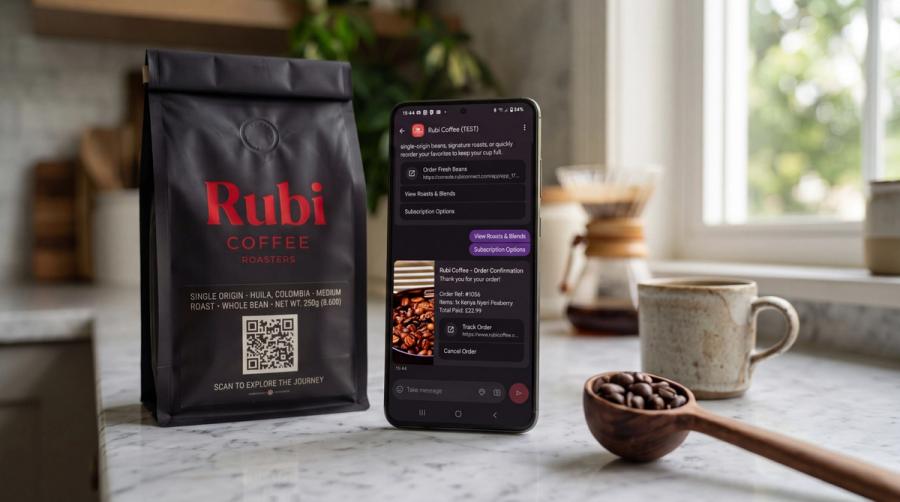
Conversational Commerce Without the Friction: The Rubi Coffee Playbook
How specialty roaster Rubi Coffee connected Shopify to WhatsApp and RCS with RubiApps to create a seamless, 24-second in-chat buying experience.
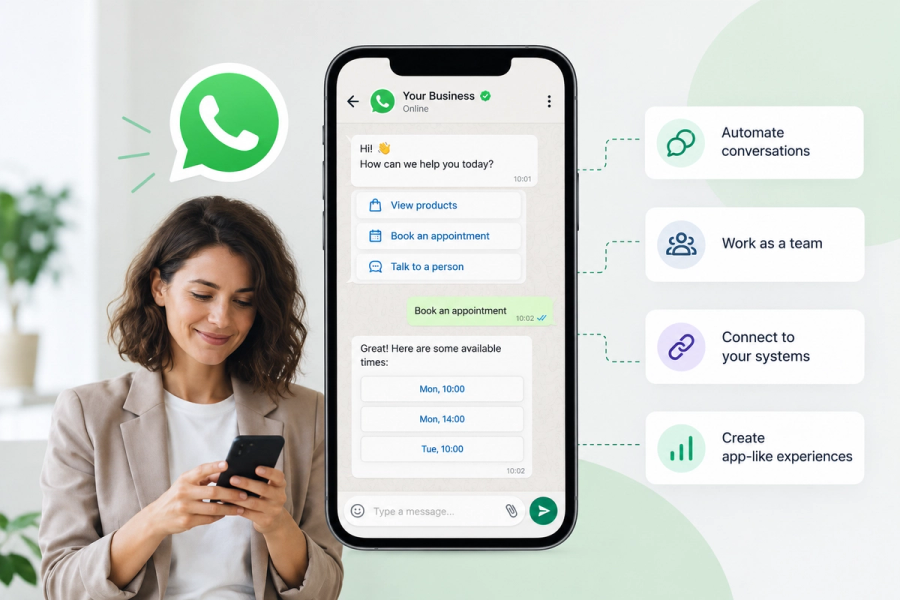
How to Get Started with WhatsApp Business in the UK: A Guide for SMEs
WhatsApp Business is easy to start with. But when your business wants to automate conversations, connect WhatsApp to its systems or create app-like customer experiences, the WhatsApp Business API opens up a whole new set of possibilities. This guide explains how to get started and what to look for in a WhatsApp Business provider in the UK.